

Description
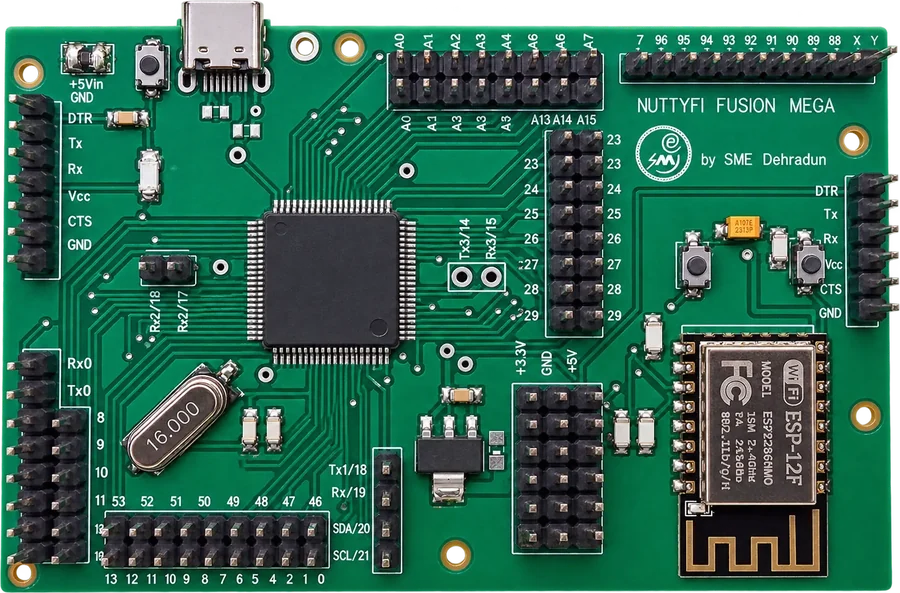
NuttyFi Fusion Mega is a dual-processor development board by SME Dehradun. It puts an ATmega2560 and an ESP-12F (ESP8266) Wi-Fi module on one board, so large projects with many sensors and outputs can go online without a second board.
Core idea: let the ATmega2560 handle a large number of inputs and outputs, while the ESP8266 handles Wi-Fi and the cloud.
What you get on the board
- ATmega2560 microcontroller: 8-bit AVR running at 16 MHz, with 256 KB flash, 8 KB RAM and 4 KB EEPROM.
- ESP-12F (ESP8266) module: 2.4 GHz Wi-Fi, 802.11 b/g/n.
- 54 digital pins and 16 analog inputs: room for many sensors, relays, displays and motors at once.
- 4 hardware serial ports, plus I2C: connect several serial devices at the same time.
- Separate programming pins for each chip: upload code to the ATmega2560 or the ESP8266 directly with a programmer, without removing anything.
- Dedicated 3.3V, 5V and GND pins: plug sensors and modules straight in, with no breadboard power rails.
- USB-C power input: power the board from any USB-C cable or adapter.
- Reset buttons on the board.
Please note: the USB-C port is for power only. Code is uploaded through the programming pins using the NuttyFi Universal Programmer.
Why Fusion Mega?
- Mega pin count with Wi-Fi built in: no separate Wi-Fi shield or module to wire up.
- Two chips, two jobs: Wi-Fi work on the ESP8266 does not slow down control code on the ATmega2560.
- One board, less wiring: cleaner builds and fewer loose jumper wires.
Perfect for:
Home and building automation, industrial monitoring, 3D printer and CNC controllers, data loggers with many sensors, robotics, and student projects that need a lot of pins and a cloud connection.
Power options:
- USB-C: 5 V from a USB cable or adapter (power only).
- +5Vin pins: for an external 5 V supply.
What you need to program it
The NuttyFi Universal Programmer, connected to the programming pins of the chip you want to upload to. It works with both the ATmega2560 and the ESP8266 on this board.